


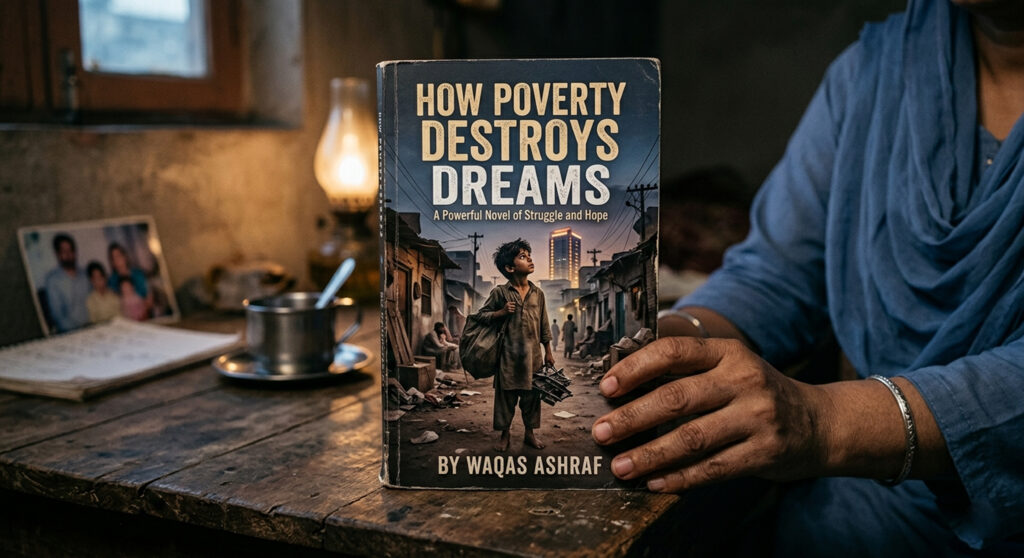
H1 The Weight of Empty Pockets
The morning sun climbed slowly over the broken rooftops of Rahim Colony, but for sixteen-year-old Ayan, the day had started long before sunrise. The cold air drifted through the cracks in the thin tin walls of his family’s small shelter. He opened his eyes to the sound of his mother coughing.
The room was barely large enough for three people. One old mattress covered the corner. A clay stove sat near the door beside an empty flour container. The smell of smoke, dust, and damp clothes filled the air.
Ayan quietly stood up and looked at his younger sister, Sana, who was sleeping under a faded blanket. Her schoolbooks rested beside her pillow. She loved school more than anything. Every night she promised herself that one day she would become a doctor.
But dreams are expensive.
Poverty had entered their lives years ago, and it stayed like an unwanted guest who refused to leave.
Ayan’s father had once worked at a textile factory in Karachi. The salary was small, but it was enough to buy food, pay rent, and keep the children in school. Then the factory closed after a financial crisis. Hundreds of workers lost their jobs overnight.
At first, Ayan’s father believed things would improve quickly.
“Just a few weeks,” he used to say.
But weeks became months.
Then came debt.
Then came hunger.
Then came hopelessness.
Now his father worked irregularly as a laborer, carrying bricks at construction sites whenever work was available. Some days he earned enough for dinner. Some days he returned home empty-handed.
That morning, Ayan’s mother handed him a small piece of bread.
“This is all that’s left,” she whispered.
Ayan divided the bread into two pieces and gave the larger half to Sana.
“You need it more,” he said.
Sana lowered her eyes. “Brother, I’m not hungry.”
But they both knew she was lying.
H2-The Invisible Pain of Poverty
People often imagine poverty as a lack of money, but poverty is much deeper than empty pockets.
Poverty steals confidence.
It steals opportunities.
It steals dignity.
Ayan understood this every day when he walked through the city looking for work. Shopkeepers judged his torn clothes before hearing his words. Wealthy people avoided eye contact with him at traffic signals. Sometimes security guards pushed him away from shopping centers as if being poor was a crime.
One afternoon, Ayan stopped near a café where students his age were laughing together. Their clean uniforms and expensive phones reminded him of the life he once imagined for himself.
He had loved mathematics.
His teacher once told him, “You think like an engineer.”
But education became impossible after his father lost work.
School fees were small for wealthy families, yet enormous for poor households.
According to international reports from organizations like the World Bank and UNICEF, millions of children around the world leave school because of poverty. Many start working early to support their families. Some never return to education.
Ayan became one of them.
Now, instead of solving equations, he carried heavy vegetable crates in the market for a few coins.
H3-The Cycle That Traps Families
Poverty often behaves like a cage passed from one generation to another.
Poor parents struggle to afford quality education.
Without education, children receive low-paying jobs.
Low-paying jobs keep families poor.
And the cycle continues.
Ayan saw this reality in nearly every house in Rahim Colony.
There was Uncle Bashir, a skilled mechanic who could repair almost any engine but never earned enough to open his own workshop.
There was Shazia, a widow sewing clothes late into the night under weak candlelight while her children searched garbage piles for recyclable plastic.
There was little Hamza, only ten years old, selling tissues at traffic lights instead of attending school.
None of them were lazy.
That was the painful truth people rarely understood.
Most poor people worked harder than anyone else.
The problem was not always effort.
The problem was limited opportunity.
H5-Hunger Changes People
One evening, Ayan returned home after failing to find work.
His father sat silently beside the stove.
“No work today?” Ayan asked.
His father shook his head.
The room remained quiet.
Silence had become common in their home because poverty creates emotional exhaustion. Constant financial stress affects mental health, relationships, and self-esteem.
Studies around the world show that poor families often experience anxiety, depression, and chronic stress. Parents feel guilt when they cannot provide for their children. Children feel shame because they cannot live like others.
That night, Sana asked softly, “Will I still go to school next month?”
Nobody answered.
Her eyes slowly filled with tears.
Ayan looked away because he could not bear the pain.
Hunger does not only weaken the body.
It weakens hope.
A Small Opportunity
One Friday afternoon, while helping unload boxes outside a bookstore, Ayan met an elderly man named Professor Kareem.
The old man noticed Ayan staring at a mathematics book.
“You like numbers?” he asked.
Ayan nodded shyly.
“I used to study before…”
Before what?
Before poverty.
But he could not say the words.
Professor Kareem invited him inside the bookstore. The shelves were filled with books about science, history, engineering, and literature.
Ayan felt as if he had entered another world.
The professor listened carefully to his story.
Then he said something Ayan would never forget:
“Being poor is not failure. Sometimes it is simply a condition created by unfair systems, bad luck, illness, corruption, or lack of opportunity. Never confuse poverty with worthlessness.”
Those words changed something inside Ayan.
For the first time in years, someone saw potential in him instead of weakness.
The professor offered him part-time work organizing books after school hours.
The salary was small, but it was honest.
More importantly, Ayan gained access to knowledge again.
Every evening after work, he read books for free.
He studied mathematics.
He learned basic computer skills.
He improved his English.
Slowly, hope returned.
Real Causes of Poverty
Poverty is not caused by one single reason.
Different families become poor for different reasons.
Some lose jobs because industries close.
Some suffer from war or natural disasters.
Others face corruption, weak education systems, rising inflation, or unequal distribution of wealth.
In many countries, healthcare costs also push families into poverty. One medical emergency can destroy years of savings.
Climate change has become another modern cause. Farmers lose crops due to floods, droughts, and extreme weather.
Technology has improved many lives, but it has also replaced some traditional jobs.
Experts today emphasize that solving poverty requires long-term solutions:
- Better education
- Fair wages
- Access to healthcare
- Economic stability
- Skill development
- Equal opportunities
- Honest governance
Charity helps temporarily, but sustainable opportunities create permanent change.
The Turning Point
Months passed.
Ayan continued working at the bookstore while studying at night.
One day, Professor Kareem helped him apply for a scholarship program designed for low-income students.
The competition was difficult.
Thousands applied.
Only fifty students were selected.
Ayan waited anxiously for weeks.
Then one afternoon, a letter arrived.
His hands trembled as he opened it.
“Congratulations.”
He had been accepted.
His mother cried.
His father covered his face with his hands.
Sana jumped with excitement.
For the first time in years, the family’s tears came from happiness instead of fear.
Poverty Does Not Define Humanity
Years later, Ayan became a civil engineer.
He did not become rich overnight.
Success arrived slowly through education, discipline, and support from people who believed in him.
But he never forgot Rahim Colony.
He returned often to help students from poor families continue their education.
Whenever someone called poor people “lazy” or “useless,” he remembered the exhausted workers he had known as a child.
He remembered mothers skipping meals so children could eat.
He remembered fathers searching endlessly for jobs.
He remembered children carrying responsibilities far beyond their age.
And he understood something important:
Poverty is not only about economics.
It is about human struggle.
Behind every poor family is a story filled with sacrifice, pain, survival, and silent courage.
Some people escape poverty.
Many do not.
But every person deserves dignity, opportunity, and respect regardless of financial status.
Because no human being chooses suffering.
And sometimes the difference between poverty and success is not talent.
It is simply one opportunity.
Conclusion
The story of Ayan reflects the reality faced by millions around the world today. Poverty affects education, health, confidence, and future opportunities. It creates emotional pain that many wealthy societies fail to notice.
However, poverty is not permanent for everyone. With access to education, fair opportunities, community support, and economic stability, lives can change.
The most important lesson is this:
Poor people do not need pity alone.
They need opportunity.
They need systems that reward hard work fairly.
They need education that remains accessible.
And above all, they need society to recognize their humanity.
Because even in the darkest conditions, hope can survive.
And sometimes hope is the first step out of poverty.
About The Author