


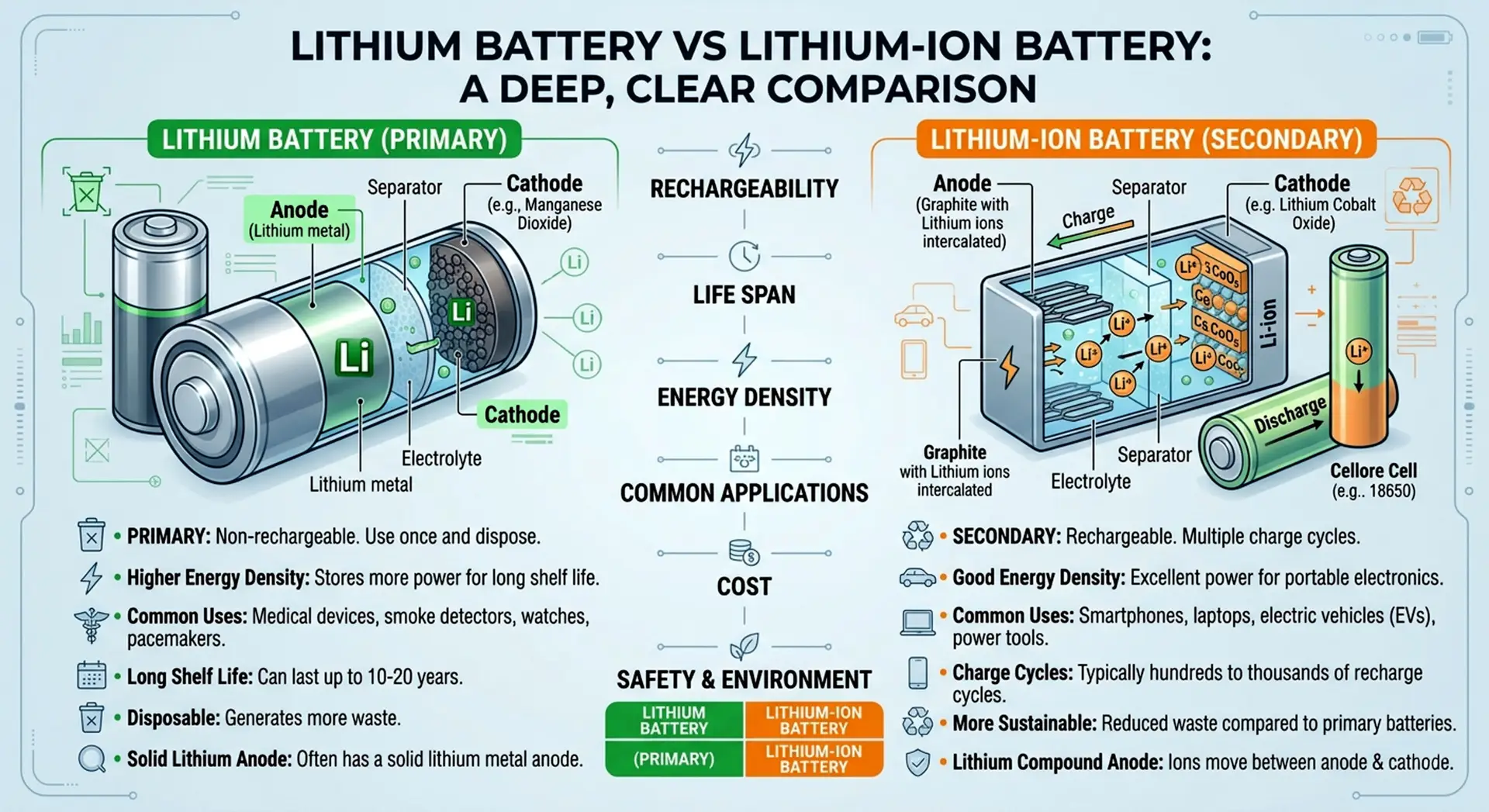
Lithium Battery vs Lithium-Ion Battery
A Deep, Clear Comparison
Energy storage technology has become one of the most critical pillars of modern life. From smartphones and laptops to electric vehicles and renewable energy systems, batteries power the world. Among the most commonly discussed are lithium batteries and lithium-ion batteries—terms often used interchangeably, but they are not the same. Understanding their differences is essential for making informed decisions about technology, safety, and performance.
1. What Is a Lithium Battery?
A lithium battery (more precisely, a lithium metal battery) is a type of primary (non-rechargeable) battery that uses metallic lithium as the anode.
Key Characteristics:
- Single-use (non-rechargeable)
- High energy density
- Lightweight
- Long shelf life (often 10+ years)
- Stable in storage
How It Works:
Lithium metal batteries generate electricity through a chemical reaction between lithium metal and a cathode material (often manganese dioxide or sulfur dioxide). Once the lithium is consumed, the battery cannot be recharged.
Common Uses:
- Watches
- Remote controls
- Medical devices (e.g., pacemakers)
- Military equipment
- Backup power systems
Real Example:
Think of the coin cell battery (CR2032) inside a car key or motherboard. That’s a lithium metal battery—small, reliable, and designed to last years without replacement.
2. What Is a Lithium-Ion Battery?
A lithium-ion (Li-ion) battery is a secondary (rechargeable) battery that stores and releases energy through the movement of lithium ions between electrodes.
Key Characteristics:
- Rechargeable (hundreds to thousands of cycles)
- High energy efficiency
- Widely used in modern electronics
- Requires protection circuits
How It Works:
Instead of using lithium metal, lithium-ion batteries use lithium compounds. During charging and discharging:
- Lithium ions move between the anode (usually graphite) and the cathode (such as lithium cobalt oxide)
- Electrons flow through an external circuit, powering devices
Common Uses:
- Smartphones
- Laptops
- Electric vehicles (EVs)
- Power banks
- Solar energy storage systems
Real Example:
Every time you charge your phone, you’re using a lithium-ion battery. It can recharge hundreds of times while maintaining performance.
3. Core Differences Between Lithium and Lithium-Ion Batteries
Let’s break down the fundamental differences in a clear, structured way.
A. Rechargeability
- Lithium battery: Not rechargeable
- Lithium-ion battery: Rechargeable
This is the most important distinction. Lithium metal batteries are disposable, while lithium-ion batteries are built for repeated use.
B. Chemical Composition
- Lithium battery: Uses pure lithium metal
- Lithium-ion battery: Uses lithium compounds (no free lithium metal)
This difference is critical for safety and performance. Lithium metal is highly reactive, making rechargeability difficult and dangerous.
C. Energy Density
- Lithium batteries generally have higher initial energy density
- Lithium-ion batteries offer sustained, reusable energy over time
In simple terms:
- Lithium battery = stronger one-time output
- Lithium-ion = long-term usability
D. Lifespan
- Lithium battery: Long shelf life but single-use
- Lithium-ion battery: Limited by charge cycles (typically 300–1500)
E. Cost Efficiency
- Lithium batteries are cheaper for low-power, long-term storage
- Lithium-ion batteries are more cost-effective for frequent use
F. Safety
- Lithium metal batteries are generally stable when unused
- Lithium-ion batteries can overheat if damaged or improperly charged
However, modern lithium-ion batteries include:
- Thermal management systems
- Battery management systems (BMS)
- Overcharge protection
4. Real-World Comparison
Scenario 1: Car Key vs Smartphone
- A car key uses a lithium battery because:
- It needs low power
- It must last years without replacement
- No recharging is required
- A smartphone uses lithium-ion because:
- It consumes high power daily
- It must be rechargeable
- Users expect long-term usability
Scenario 2: Medical Devices
Some implants like pacemakers use lithium batteries because:
- Reliability is critical
- Long shelf life is essential
- Recharging is not practical inside the human body
Scenario 3: Electric Vehicles (EVs)
Electric vehicles rely entirely on lithium-ion batteries because:
- They require repeated charging
- High energy storage is needed
- Efficiency and weight matter
5. Advantages and Disadvantages
Lithium Batteries (Lithium Metal)
Advantages:
- Extremely long shelf life
- Lightweight
- Reliable in extreme temperatures
- Low maintenance
Disadvantages:
- Cannot be recharged
- Limited to low-drain applications
- Disposal concerns
Lithium-Ion Batteries
Advantages:
- Rechargeable
- High energy efficiency
- Suitable for high-power devices
- Widely available
Disadvantages:
- Degrades over time
- Sensitive to heat and overcharging
- More complex design
6. Latest Developments (2024–2026 Trends)
Battery technology is evolving rapidly. Here are some important updates:
A. Solid-State Batteries
Scientists are developing solid-state lithium batteries, which aim to:
- Replace liquid electrolytes
- Improve safety
- Increase energy density
These could eventually outperform current lithium-ion batteries, especially in electric vehicles.
B. Lithium Iron Phosphate (LFP)
A newer type of lithium-ion battery:
- More stable and safer
- Longer lifespan
- Slightly lower energy density
Widely used in electric vehicles and solar systems.
C. Recycling and Sustainability
With growing environmental concerns:
- Lithium-ion recycling is becoming a major industry
- Companies are recovering lithium, cobalt, and nickel
- Governments are introducing battery regulations
D. Fast Charging Improvements
Modern lithium-ion batteries now support:
- Ultra-fast charging (0–80% in under 30 minutes)
- Better thermal management systems
7. When Should You Choose Each?
Choose Lithium Batteries If:
- You need long shelf life
- The device uses very low power
- Recharging is not practical
Examples:
- Remote sensors
- Emergency equipment
- Backup memory systems
Choose Lithium-Ion Batteries If:
- You need frequent recharging
- The device consumes high power
- You want long-term usability
Examples:
- Phones, laptops
- Electric vehicles
- Power tools
8. Common Misconception
Many people say “lithium battery” when referring to phone batteries. This is incorrect.
👉 Your phone uses a lithium-ion battery, not a lithium metal battery.
This confusion happens because both technologies involve lithium, but their design and usage are completely different.
9. Safety Considerations
For Lithium Batteries:
- Avoid puncturing or crushing
- Store in dry, cool environments
- Dispose properly
For Lithium-Ion Batteries:
- Use original chargers
- Avoid overheating
- Do not overcharge or fully drain regularly
Conclusion
While lithium batteries and lithium-ion batteries share a common element, they serve very different purposes. Lithium batteries excel in long-term, low-power applications, offering reliability and simplicity. Lithium-ion batteries, on the other hand, dominate modern technology due to their rechargeability, efficiency, and versatility.
As battery technology continues to evolve, especially with innovations like solid-state batteries, the gap between performance, safety, and sustainability will continue to shrink. Understanding these differences not only helps in choosing the right battery but also in using it safely and efficiently.
About The Author