
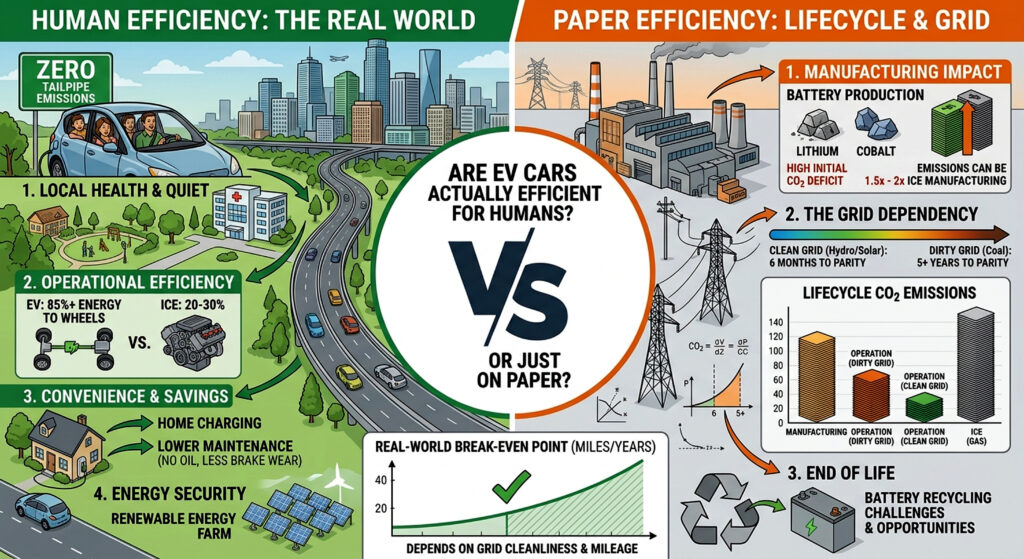
Every electric vehicle ad shows the same number: some impressive miles-per-kWh figure, a sleek dashboard, a driver smiling at a charging station like it’s a spa day. What those ads don’t show is the actual human behind the wheel — someone who forgets to plug in overnight, blasts the AC at full power, and takes the long way home because the GPS rerouted through traffic.
Are EV Cars Actually Efficient for Humans, or Just on Paper?
So the real question isn’t “are EVs efficient?” Automakers have already answered that with kilowatt-hour math. The real question is whether EV cars are efficient for humans — for the way real people actually drive, charge, plan, and live. That’s a different question, and the answer is more interesting than a spec sheet.
What “Efficiency” Actually Means Once a Human Is Driving
Energy Conversion vs. Lived Experience
On a pure physics level, EVs convert roughly 85–90% of the electricity from the wall into actual motion. A gasoline engine wastes most of its fuel as heat, converting somewhere around 20–30% into forward motion. That gap is real, and it’s the foundation of every “EVs are more efficient” claim you’ll see online.
But a human doesn’t experience kilowatt-hours. A human experiences whether the car was charged this morning, whether the heater drained the range faster than expected, and whether the nearest fast charger had a working cable. Mechanical efficiency and human efficiency are two separate scoreboards, and most discussions only ever talk about the first one.
The Gap Between Lab Numbers and Real Life
EPA range estimates and manufacturer efficiency ratings are measured under controlled conditions: moderate temperatures, steady speeds, no cargo, no detours. Real driving rarely looks like that. Cold weather alone can cut usable range by 20–40%, according to multiple independent testing groups including AAA. Add hills, aggressive acceleration, or a roof rack, and the “efficient” number on the window sticker starts to feel theoretical.
This doesn’t mean EVs are inefficient. It means the efficiency a person actually gets depends heavily on habits the spec sheet never accounts for.
Table of Contents
Where EVs Genuinely Make Life Easier for People
Stop-and-Go Traffic Works in Your Favor
This is the part most combustion-car owners don’t expect: city driving, the kind that destroys a gas car’s fuel economy, is where EVs shine. Regenerative braking recovers energy every time you slow down, so the daily grind of traffic lights and school-zone crawling barely dents an EV’s range the way it guts a gasoline engine’s mileage. For anyone whose daily life is short trips and constant braking — most commuters, honestly — this is a quiet, underrated win.
Maintenance Becomes a Non-Event
Human efficiency isn’t just about energy; it’s about time and mental load. No oil changes, no transmission fluid, no exhaust system to worry about, far fewer moving parts to fail. Brake pads even last longer because regenerative braking does most of the slowing down. For a household, this translates into fewer surprise repair bills and fewer afternoons lost at a service center — a form of efficiency that never shows up in a kWh chart but absolutely shows up in someone’s calendar.
Where Human Habits Undercut EV Efficiency
Charging Behavior Is the Biggest Variable
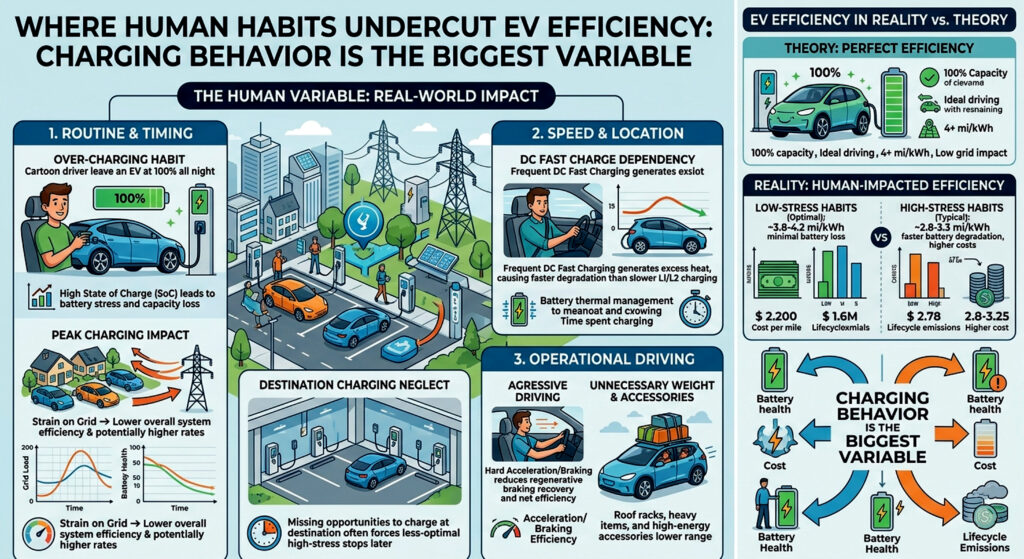
An EV charged every night at home on a steady routine behaves completely differently from one that’s only ever topped up in a panic at a public fast charger. Frequent fast-charging generates more heat and stress on the battery than slow overnight charging, and it’s also simply less convenient — standing around for 30–40 minutes instead of just plugging in before bed. The car’s efficiency doesn’t change; the owner’s experience of that efficiency changes dramatically.
Comfort Settings Compete With Range
Climate control is the most underestimated drain on an EV. Unlike a gas engine, which produces heat as a byproduct of combustion, an EV has to generate cabin heat from the same battery that powers the wheels. Running the heater on a winter commute can pull as much energy as a meaningful chunk of your daily driving. Most people aren’t going to sit in a cold car to preserve range, and that’s a perfectly reasonable choice — but it’s a real-world efficiency cost that lab tests rarely capture.
Driving Style Still Matters, Maybe More Than in Gas Cars
Instant torque is one of the most fun parts of driving electric, and it’s also one of the easiest ways to quietly erase your efficiency gains. Hard acceleration draws disproportionately more power than smooth, gradual driving. Long-term, that habit also accelerates battery degradation faster than gentler use. The car rewards patience in a way gas vehicles never really did.
Practical Ways Humans Can Actually Get the Efficiency They Were Promised
A few habit shifts close most of the gap between the brochure numbers and daily reality:
Charging overnight on a consistent schedule keeps the battery in a healthier state and avoids the inefficiency of frequent fast-charging stops. Preconditioning the cabin while the car is still plugged in — warming it up before unplugging — lets you draw that comfort energy from the wall instead of the battery. Planning longer trips around charger locations, the way people once planned around gas stations, removes most of the anxiety that leads to inefficient detours. And easing off the accelerator, even slightly, recovers a surprising amount of range simply because EV motors are so responsive to demand.
None of these are difficult. They’re just unfamiliar, because combustion driving never asked for this kind of attention.
So, Are EVs Efficient for Humans? The Honest Verdict
Mechanically, yes — convincingly so. An EV will almost always turn electricity into motion more effectively than a gas engine turns fuel into motion. But “efficient for humans” depends on something engineers can’t fully control: the person behind the wheel.
For someone with home charging, a short-to-moderate commute, and a willingness to adjust a few habits, an EV isn’t just efficient on paper — it quietly removes friction from daily life in ways a gas car never could. For someone who relies entirely on public fast charging, drives aggressively, and ignores preconditioning, that same car will feel far less impressive than the spec sheet promised.
The technology has done its part. The remaining efficiency gap is mostly human, and that’s actually good news — because unlike battery chemistry, human habits are something you can change starting with your very next drive.
What Does “Can EV Cars Be Efficented in Humans?” Mean?
The phrase can be interpreted as asking whether electric vehicles create positive outcomes for people and society.
In practical terms, this includes:
- Improving air quality
- Reducing transportation costs
- Enhancing driving experiences
- Supporting environmental sustainability
- Creating healthier living environments
Rather than focusing solely on vehicle performance, this question examines the broader relationship between EV technology and human well-being.
How Electric Vehicles Improve Human Health
One of the strongest arguments supporting electric vehicles is their potential impact on public health.
Reduced Air Pollution
Traditional gasoline and diesel vehicles release pollutants such as:
- Carbon monoxide
- Nitrogen oxides
- Particulate matter
- Volatile organic compounds
These emissions contribute to respiratory illnesses and poor air quality, particularly in densely populated cities.
Electric vehicles produce zero tailpipe emissions, helping reduce harmful pollutants that directly affect human health.
Cleaner Urban Environments
Cities with a higher percentage of electric vehicles often experience improvements in local air quality. Cleaner air can lead to:
- Fewer respiratory problems
- Lower rates of asthma
- Improved cardiovascular health
- Better overall quality of life
For many families living near busy roads, reduced vehicle emissions can make a meaningful difference.
Environmental Benefits That Support Human Life
Lower Carbon Emissions
Climate change affects people through:
- Extreme weather events
- Rising temperatures
- Food supply disruptions
- Increased health risks
Electric vehicles help reduce greenhouse gas emissions, especially when charged using renewable energy sources.
Although EV production has environmental impacts, studies consistently show that their lifetime emissions are generally lower than traditional gasoline vehicles.
Supporting Sustainable Transportation
Sustainable transportation is becoming essential as global populations grow and cities become more crowded.
Electric vehicles contribute by:
- Reducing dependence on fossil fuels
- Supporting renewable energy integration
- Encouraging greener infrastructure
These long-term benefits can positively influence future generations.
Financial Efficiency for Individuals
Lower Fuel Costs
One of the biggest advantages of EV ownership is reduced operating expenses.
Electricity is often significantly cheaper than gasoline when measured per mile traveled.
Drivers who charge their vehicles at home can often save substantial amounts annually compared to traditional fuel-powered vehicles.
Reduced Maintenance Requirements
Electric vehicles contain fewer moving parts than internal combustion engine vehicles.
This means:
- No oil changes
- Fewer engine repairs
- Less wear on mechanical components
- Lower maintenance costs
Over several years, these savings can become significant.
Long-Term Ownership Benefits
Although some EVs have higher upfront purchase prices, many owners recover costs through:
- Fuel savings
- Lower maintenance expenses
- Government incentives
- Tax benefits
For many consumers, electric vehicles become more cost-effective over time.
Driving Experience and Human Comfort
Quiet Operation
Electric vehicles operate much more quietly than conventional vehicles.
Benefits include:
- Reduced noise pollution
- Less driving fatigue
- More comfortable commuting
Noise pollution is increasingly recognized as a factor affecting mental well-being in urban environments.
Instant Torque and Smooth Acceleration
Electric motors provide immediate power delivery.
Drivers often enjoy:
- Faster acceleration
- Smoother driving experiences
- Improved responsiveness
These features contribute to both convenience and driving satisfaction.
Advanced Technology Features
Many modern EVs include:
- Smart navigation systems
- Driver-assistance technologies
- Remote vehicle monitoring
- Over-the-air software updates
These innovations improve convenience and overall user experience.
Challenges of Electric Vehicles
While EVs offer many advantages, they are not perfect.
Charging Infrastructure Limitations
In some regions, charging stations remain limited.
Potential challenges include:
- Long-distance travel planning
- Charging wait times
- Uneven infrastructure development
However, charging networks continue expanding rapidly worldwide.
Battery Production Concerns
Battery manufacturing requires materials such as:
- Lithium
- Nickel
- Cobalt
Mining these resources creates environmental and ethical concerns that manufacturers are actively working to address through recycling and alternative battery technologies.
Higher Initial Purchase Costs
Although prices continue falling, some electric vehicles remain more expensive upfront compared to similar gasoline-powered models.
This can make adoption difficult for budget-conscious consumers.
Can EV Cars Be More Efficient Than Traditional Vehicles?
Energy Efficiency Comparison
Electric vehicles convert a much higher percentage of stored energy into movement.
Approximate efficiency:
- Electric vehicles: 70–90%
- Gasoline vehicles: 20–40%
This means EVs waste significantly less energy during operation.
Regenerative Braking Technology
Most EVs use regenerative braking systems that recover energy normally lost during braking.
Benefits include:
- Increased efficiency
- Extended driving range
- Reduced brake wear
This technology further improves overall vehicle performance.
The Human Perspective: Beyond Transportation
The discussion around whether can EV cars be efficented in humans extends beyond vehicles themselves.
Electric vehicles influence:
Urban Planning
Cities are increasingly designed around sustainable transportation systems.
EV adoption supports:
- Cleaner public spaces
- Reduced traffic emissions
- Smarter transportation infrastructure
Economic Opportunities
The electric vehicle industry creates jobs in:
- Manufacturing
- Battery production
- Software development
- Charging infrastructure
Economic growth ultimately benefits communities and individuals.
Future Innovation
The rise of electric vehicles encourages innovation in:
- Renewable energy
- Energy storage
- Smart grids
- Autonomous transportation
These technologies may shape a more efficient future for society.
Common Misconceptions About EV Efficiency
EVs Are Not Completely Emission-Free
While EVs produce no tailpipe emissions, electricity generation and manufacturing still contribute to environmental impacts.
However, their overall environmental footprint is generally lower over their lifetime.
EV Batteries Do Not Last Forever
Battery degradation occurs over time, although modern batteries often last many years before requiring replacement.
Charging Is Becoming Easier
Many people assume charging is difficult, but charging infrastructure continues expanding rapidly across urban and rural areas.
Conclusion
So, can EV cars be Efficented in humans? The evidence suggests that electric vehicles can significantly benefit people in multiple ways. They improve air quality, reduce transportation costs, provide a smoother driving experience, and support environmental sustainability.
While challenges such as charging infrastructure and battery production remain, ongoing technological advancements continue addressing these concerns. For many individuals and communities, electric vehicles represent not just a new form of transportation but a meaningful step toward a cleaner, healthier, and more efficient future.
As adoption grows worldwide, EVs are increasingly proving that they can positively impact both human life and the environment, making them an important part of the future of mobility.
FAQs
Are EV cars more efficient than gas cars for everyday driving?
Yes, in most everyday scenarios. EVs convert a much higher share of stored energy into actual motion, and they perform especially well in stop-and-go city traffic, where regenerative braking recovers energy that a gas engine would simply waste as heat.
Why doesn’t my EV match the range listed by the manufacturer?
Manufacturer range figures come from controlled testing conditions: moderate temperatures, steady speeds, and no extra load. Cold weather, hilly terrain, heavy cargo, and aggressive driving can all reduce real-world range well below the advertised number.
Does cold weather really affect EV efficiency that much?
It does. Heating the cabin draws energy directly from the same battery that powers the wheels, since EVs don’t generate waste heat from combustion the way gas engines do. Depending on conditions, this can noticeably shorten how far a charge will take you.
Is fast charging bad for EV efficiency or battery health?
Occasional fast charging is fine, but relying on it constantly generates more heat and stress on the battery than slow, steady overnight charging. For both efficiency and long-term battery health, home charging on a regular schedule is generally the better habit.
Can driving style actually change how efficient an EV is?
Yes, more than many drivers expect. EV motors respond instantly to acceleration demands, so frequent hard acceleration draws disproportionately more power than smooth, gradual driving — and it can also speed up battery degradation over time.
What’s the easiest way to improve EV efficiency without changing my driving much?
Precondition the cabin while the car is still plugged in. Warming or cooling the interior before you unplug lets that energy come from the wall instead of the battery, which preserves range without requiring you to drive any differently.
Are EVs efficient for people who don’t have home charging?
They can still be efficient mechanically, but the daily experience is harder. Without home charging, you’re more dependent on public fast chargers, which tend to be less convenient and slightly less efficient than a consistent overnight charging routine.
Can EV cars be Efficient in humans?
Yes, electric vehicles can positively impact human life by reducing air pollution, lowering transportation costs, and supporting a cleaner environment. Their efficiency and sustainability make them beneficial for both individuals and communities.
How do electric vehicles improve human health?
Electric vehicles produce zero tailpipe emissions, which helps reduce air pollution. Cleaner air can lower the risk of respiratory illnesses, asthma, and other health problems associated with vehicle emissions.
Are EV cars more energy-efficient than gasoline vehicles?
Yes. Electric vehicles typically convert 70–90% of their stored energy into movement, while gasoline-powered vehicles usually convert only 20–40% of fuel energy into usable power.
Do electric vehicles save money over time?
In many cases, yes. EV owners often spend less on fuel, maintenance, and repairs because electric vehicles have fewer moving parts and do not require oil changes.
5. Are electric vehicles environmentally friendly?
Electric vehicles are generally more environmentally friendly than traditional vehicles because they produce no tailpipe emissions and help reduce greenhouse gas emissions over their lifetime.
What are the biggest advantages of EV cars for humans?
The main advantages include cleaner air, lower operating costs, quieter driving, improved energy efficiency, and reduced dependence on fossil fuels.
What challenges do electric vehicles still face?
Some challenges include limited charging infrastructure in certain areas, battery production concerns, charging times, and higher upfront purchase costs compared to some gasoline vehicles.
Can electric vehicles help reduce climate change?
Electric vehicles can contribute to reducing climate change by lowering carbon emissions, especially when charged using renewable energy sources such as solar or wind power.
How long do EV batteries typically last?
Most modern EV batteries are designed to last between 8 and 15 years or longer, depending on usage, charging habits, and environmental conditions.
Are electric vehicles the future of transportation?
Many experts believe electric vehicles will play a major role in the future of transportation due to advancements in battery technology, government support, and growing demand for sustainable mobility solutions.