
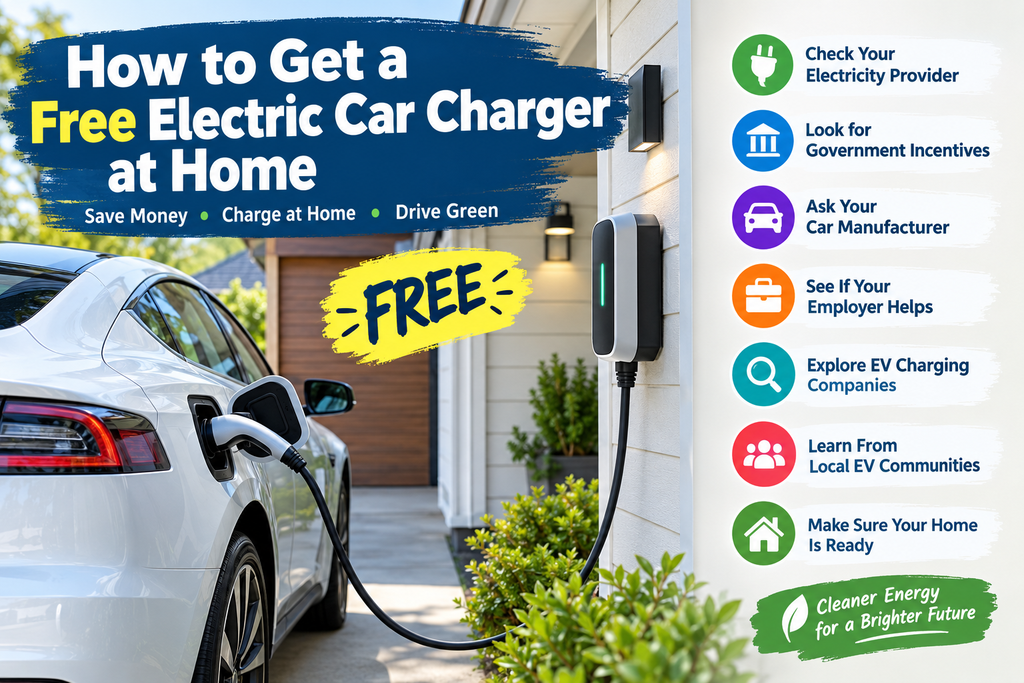
Electric cars are becoming more popular every year. They are quieter than traditional vehicles, cheaper to run in many situations, and can help reduce fuel costs. But there is one question many new electric vehicle owners ask before making the switch: How can I charge my electric car at home without spending a lot of money?
The good news is that you may not always have to pay the full cost of installing a home EV charger. Depending on where you live, your electricity provider, local government, car manufacturer, employer, or another organization may offer a free charger, installation discount, rebate, or other incentive.
Getting a completely free charger is not guaranteed for everyone, but there are several places worth checking. The key is knowing where to look and understanding what each offer actually covers.
What Does a Free Home EV Charger Really Mean?
Before searching for a free electric car charger, it is important to understand what “free” means in different programs.
Some offers provide the charger hardware at no cost, but you may still have to pay for installation. Other programs cover both the charger and professional installation. Some give you a rebate after you purchase and install the charger yourself.
There are also programs that offer a charger for free but require you to enroll in a particular electricity plan or allow the energy company to manage when your vehicle charges.
Free Charger vs. Free Installation
A free charger and free installation are two different things.
For example, an electricity company might give you a wall-mounted EV charger for free, while you pay an electrician to install a suitable electrical circuit. Another program might cover both the equipment and installation but have limits on the type of property or vehicle that qualifies.
Always read the conditions before assuming that the entire installation will cost nothing.
Check Your Electricity Provider First
One of the best places to start is your electricity provider.
Utility companies sometimes offer incentives to encourage customers to purchase electric vehicles. These programs can include rebates, discounted charging equipment, installation assistance, or special electricity rates for EV owners.
Ask About EV Charging Programs
Contact your electricity provider and ask specific questions.
You can ask:
- Do you offer rebates for home EV chargers?
- Is there a free charger program for electric vehicle owners?
- Do you offer installation assistance?
- Are there special EV electricity tariffs?
- Is a smart charger required?
- Do I need to enroll in a managed charging program?
- Are there income-based incentives?
Some programs may not advertise heavily, so speaking directly with the provider can sometimes reveal options that are easy to miss online.
- What Does a Free Home EV Charger Really Mean?
- Free Charger vs. Free Installation
- Look for Government EV Incentives
- Renters Can Also Look for Charging Assistance
- Verify the Program
- Final Thoughts
- Frequently Asked Questions About Free Electric Car Chargers
- Can I really get a free electric car charger at home?
- Does a free EV charger include installation?
- How can I find free EV charger programs in my area?
- Do electric car manufacturers give free home chargers?
- Can renters get a free home EV charger?
- Are there free EV chargers for low-income households?
- Is a free EV charger really free?
- What type of charger should I install at home?
- Do I need an electrician to install an EV charger?
- Can my electricity company give me a free EV charger?
- How much money can I save with a free home EV charger?
- Should I accept any offer that says “free EV charger”?
- By Waqas Ashraf
Look for Government EV Incentives
Government programs are another possible source of help.
National, provincial, state, or local authorities may offer financial incentives for electric vehicle charging infrastructure. These programs can change frequently, so it is important to check current information rather than relying on an old article or social media post.
Check Local Programs
Start with your local government website and search for terms such as:
“EV charger rebate,” “electric vehicle incentive,” “home charging grant,” or “electric vehicle charging program.”
Depending on the program, assistance might be available for homeowners, renters, businesses, or people purchasing their first electric vehicle.
Income-Based Assistance
Some charging programs are designed specifically for households with lower or moderate incomes.
These programs may provide a larger rebate or cover a greater percentage of installation costs. You may need to provide proof of income or meet other eligibility requirements.
If you qualify for an income-based program, the savings can be significantly greater than a standard EV charger rebate.
Ask the Electric Car Manufacturer
Your car manufacturer may also have charging offers.
Some automakers provide free charging equipment, installation credits, charging subscriptions, or promotional charging packages when customers purchase or lease certain electric vehicles.
Check Your Purchase Agreement
If you recently purchased an EV, look through the documents that came with the vehicle. Check the manufacturer’s website and contact the dealership where you bought the car.
Ask whether your vehicle purchase includes:
- A free home charger
- Installation credit
- Charging equipment discount
- Free public charging
- Home charging incentives
These offers can sometimes have an expiration date, so don’t wait too long to claim them.
Check With Your Employer
Your workplace may be able to help as well.
Companies are increasingly adding electric vehicle benefits to attract employees and support cleaner transportation. Some employers provide EV charging at the workplace, while others may offer financial assistance for employees who install chargers at home.
Ask Your HR Department
Contact your human resources department and ask whether the company has an electric vehicle benefit.
Even if your employer does not provide a free home charger, it may offer another benefit that reduces your overall charging expenses.
Some companies also work with EV charging providers to offer discounted equipment to employees.
Search for EV Charging Companies
Charging equipment companies occasionally run promotional campaigns.
A company may offer discounted or free hardware in exchange for signing up for a particular service, electricity plan, or smart-charging program.
Read the Terms Carefully
A charger advertised as “free” may come with conditions.
For example, you might have to:
- Sign a long-term agreement
- Pay a monthly service fee
- Use a specific electricity plan
- Allow remote charging management
- Pay an installation fee
- Return the charger if you leave the program
None of these conditions automatically make the offer bad, but you should understand what you are agreeing to before signing anything.
Ask Your Local EV Community
Local electric vehicle owners can be a surprisingly useful source of information.
Join local EV groups, community forums, or social media groups and ask other owners about available charging incentives in your area.
People who have recently installed chargers may know about programs that are difficult to find through a general internet search.
Learn From Other EV Owners
Ask questions such as:
- Which company installed your charger?
- Did you receive a rebate?
- How much did installation cost?
- Did your electricity provider offer assistance?
- Was the application process difficult?
- Were there unexpected fees?
Real-world experiences can help you avoid costly mistakes.
Renters Can Also Look for Charging Assistance
You do not necessarily need to own a house to benefit from EV charging programs.
Renters should speak with their landlord or property manager before installing equipment. Some landlords may be willing to install an EV charger because it can increase the property’s appeal to future tenants.
Talk to Your Landlord
Explain that you are willing to follow professional installation requirements and ask whether the property can support an EV charger.
If the landlord does not want a permanent installation, a portable charging solution may sometimes be an alternative, depending on the electrical setup and local regulations.
Never connect an EV charger to an unsuitable electrical outlet simply to avoid installation costs. Charging an electric vehicle can place a significant load on an electrical circuit.
Make Sure Your Home Is Ready
Getting a free charger does not necessarily mean you can install it anywhere.
A qualified electrician should check your home’s electrical system before installing a higher-powered charger.
Electrical Capacity Matters
Older homes may need electrical upgrades before supporting a Level 2 charger. The electrician may need to install a dedicated circuit, upgrade wiring, replace a breaker, or make other changes.
These upgrades can cost money even when the charger itself is free.
This is why it is important to ask exactly what an incentive covers.
Compare the Total Cost
When you find a free charger offer, don’t look only at the word “free.”
Calculate the complete cost.
Consider:
- Charger price
- Installation
- Electrical upgrades
- Permit fees
- Monthly service charges
- Electricity plan requirements
- Contract length
- Possible cancellation fees
A charger that costs nothing upfront may not be the cheapest option if it requires expensive ongoing fees.
Watch Out for Fake Free Charger Offers
Unfortunately, attractive EV incentives can also be used by scammers.
Be careful if someone asks for sensitive financial information before explaining the program or pressures you to pay immediately.
Verify the Program
Check whether the offer appears on the official website of the electricity provider, government agency, vehicle manufacturer, or established charging company.
Avoid sending money through unusual payment methods just to “reserve” a free charger.
If an offer sounds too good to be true, take a little time to verify it.
A Simple Way to Find a Free Charger
If you want to search efficiently, follow this order:
Step 1: Contact Your Electricity Provider
Ask about EV charger rebates, free equipment, installation programs, and special EV electricity rates.
Step 2: Check Government Incentives
Search your national, regional, and local government websites for current EV charging programs.
Step 3: Contact Your Car Manufacturer
Ask whether your vehicle purchase or lease includes charging equipment or installation assistance.
Step 4: Ask Your Employer
Check whether your workplace offers an EV benefit or charging incentive.
Step 5: Compare Private Offers
Look at charging companies and energy providers, but carefully check their terms and conditions.
Step 6: Get an Installation Quote
Even if the charger is free, find out exactly how much the electrical installation will cost.
Final Thoughts
Getting a free electric car charger for your home is possible, but it depends heavily on where you live, which vehicle you own, your electricity provider, and the programs currently available.
The best strategy is not to search for a “free charger” alone. Instead, look for EV charging rebates, installation incentives, utility programs, manufacturer offers, employer benefits, and government grants.
Remember that the cheapest charger is not always the one with the lowest purchase price. Installation quality, electrical safety, ongoing fees, warranty coverage, and compatibility with your vehicle all matter.
Before accepting any offer, read the terms carefully and confirm what is actually included. With a little research, you may be able to reduce or even eliminate much of the cost of setting up convenient EV charging at home.
Frequently Asked Questions About Free Electric Car Chargers
Can I really get a free electric car charger at home?
Yes, some electric vehicle owners can get a charger at little or no cost through utility companies, government incentives, car manufacturers, employers, or EV charging programs. However, eligibility and what is covered can vary by location and program.
Does a free EV charger include installation?
Not always. Some programs provide the charger only, while others may cover professional installation as well. Before accepting an offer, check whether electrical work, permits, wiring, and installation fees are included.
How can I find free EV charger programs in my area?
Start by contacting your electricity provider and checking your local government websites. You can also ask your vehicle manufacturer, employer, or local EV organizations about current home charging incentives.
Do electric car manufacturers give free home chargers?
Some manufacturers have offered free chargers, installation credits, or charging incentives with selected electric vehicles. These offers can depend on the vehicle model, purchase or lease agreement, location, and promotional period.
Can renters get a free home EV charger?
Renters may qualify for certain EV charging incentives, but installation usually requires permission from the landlord or property manager. Some programs also specifically include rental properties or multi-unit buildings.
Are there free EV chargers for low-income households?
In some areas, special programs provide larger rebates or assistance to households that meet certain income requirements. Check local and utility-based programs to see whether you qualify.
Is a free EV charger really free?
Not necessarily. A program advertised as free may still have installation costs, monthly fees, electricity-plan requirements, contracts, or other conditions. Always read the complete terms before signing up.
What type of charger should I install at home?
The right charger depends on your vehicle, driving habits, electrical system, and budget. A standard Level 1 charger may be enough for drivers who travel relatively little, while a Level 2 charger can provide faster home charging.
Do I need an electrician to install an EV charger?
For a permanently installed Level 2 charger, professional electrical installation is generally recommended and may be required by local rules or the incentive program. An electrician can check whether your home’s electrical system can safely handle the additional load.
Can my electricity company give me a free EV charger?
Some electricity providers offer chargers, rebates, installation assistance, or special EV charging rates. Contact your provider directly and ask about its current electric vehicle charging programs.
How much money can I save with a free home EV charger?
The savings depend on the cost of the charger, installation, electrical upgrades, and any rebate or incentive you receive. A program covering both equipment and installation can save considerably more than a charger-only offer.
Should I accept any offer that says “free EV charger”?
No. Compare the complete cost and read the terms first. Check for installation charges, monthly fees, long-term contracts, cancellation costs, and electricity-plan requirements. A free charger is only a good deal if the overall terms make sense for you.