
Introduction
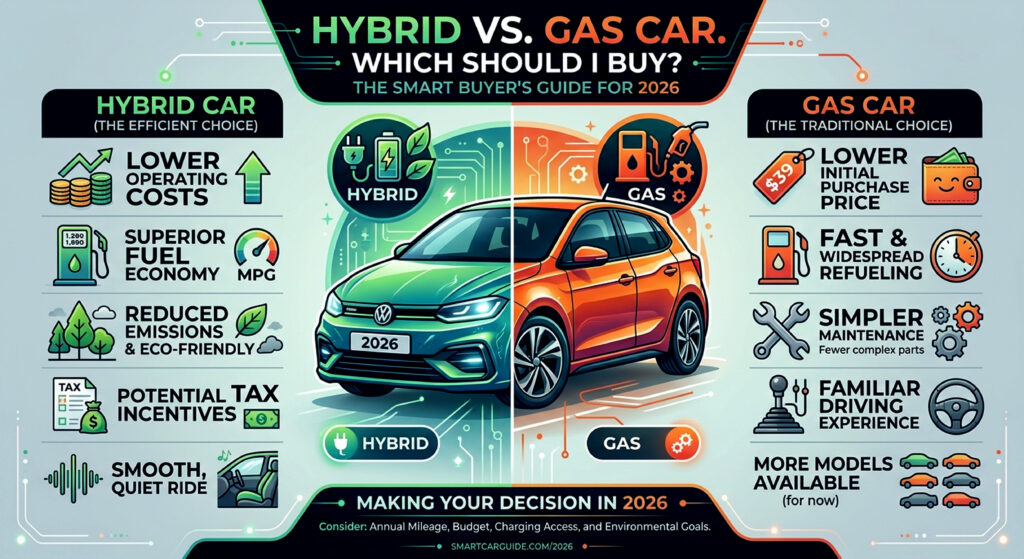
If you’re shopping for a new vehicle, one of the biggest questions you’ll face is whether to buy a hybrid car or a traditional gas-powered car. With rising fuel prices, growing environmental concerns, and advancements in automotive technology, hybrid vehicles have become increasingly popular among drivers seeking better fuel efficiency. However, conventional gasoline vehicles still offer advantages in affordability, simplicity, and widespread availability.
The answer depends on your driving habits, budget, and long-term goals. Some buyers prioritize fuel savings and lower emissions, while others focus on purchase price and maintenance costs. Understanding the differences between hybrid and gas cars can help you make a confident buying decision and maximize the value of your investment.
Hybrid vs. Gas Car. Which Should I Buy?
How Hybrid and Gas Engines Are Actually Different
A standard gas car runs on one power source: an internal combustion engine burning fuel. A hybrid pairs that same kind of engine with an electric motor and a small battery that recharges itself through regenerative braking and engine power — you never plug it in. At low speeds and during stop-and-go driving, the electric motor does most or all of the work, which is why hybrids shine in city traffic. At highway speeds, the gas engine takes over, which is why the mpg gap between hybrids and gas cars narrows considerably on long road trips.
This matters because it means a hybrid isn’t really competing with an EV — it’s a more fuel-efficient version of a normal gas car, with no charging infrastructure required and no range anxiety.
Purchase Price. The Hybrid Premium
Hybrid trims typically cost more upfront than their gas-only counterparts, often by $1,500 to $4,000 depending on the model. That premium reflects the added battery, electric motor, and power-management hardware. Some popular compact and midsize hybrids have narrowed this gap in recent model years as battery costs have come down, but it’s still rare to find a hybrid trim priced identically to its gas equivalent.
The question that actually matters isn’t “which is cheaper to buy” — it’s “how many miles will it take to close that price gap through fuel savings,” which is exactly what the next section answers.
Table of Contents
Fuel Costs. Where Hybrids Usually Win
This is the category where hybrids earn their reputation. A hybrid commonly returns 20-40% better fuel economy than the gas version of the same vehicle, with the biggest advantage showing up in city and stop-and-go driving. Someone who commutes through traffic five days a week will see a faster payback period than someone who mostly drives highway miles, since hybrids lose part of their efficiency edge at sustained highway speeds.
A rough way to think about it: take the price premium of the hybrid trim, divide it by your estimated annual fuel savings, and you get a payback timeline. For many drivers with a meaningful daily commute, that timeline lands somewhere between three and six years. If you put on fewer than 8,000-10,000 miles a year, or you do mostly highway driving, the math gets a lot less favorable.
Maintenance and Repair Costs
Hybrids use regenerative braking, which means brake pads tend to last longer than on a comparable gas car — often a real, if modest, savings over time. Routine maintenance like oil changes, filters, and tires is essentially the same between the two.
The cost question people actually worry about is hybrid battery replacement. In practice, this is less of a concern than it used to be. Hybrid battery packs from major manufacturers are commonly warrantied for 8-10 years or 100,000-150,000 miles, and real-world failure rates within that window are low. Out-of-warranty replacement costs have also dropped as the technology has matured, though it still isn’t free. For most owners who sell or trade in within a decade, this never becomes an out-of-pocket expense at all.
Resale Value and Depreciation
Hybrids have historically held their value at least as well as gas cars, and in some popular compact and midsize models, slightly better — buyers shopping the used market specifically search for hybrid trims because they want the fuel savings without paying new-car prices. That demand props up resale value. The exception is hybrid models that were never popular new; thin demand for the new version usually means thin demand used, regardless of fuel type.
Driving Feel and Performance
Modern hybrids don’t feel like a compromise the way early hybrid models sometimes did. Electric motor torque is available instantly, which actually makes a lot of hybrids feel quicker off the line in city driving than their gas counterparts. Where gas cars still tend to have an edge is in sustained acceleration at higher speeds and in the simpler, more direct feel some drivers prefer from a conventional drivetrain. For most daily driving and commuting, the difference is small enough that it shouldn’t be the deciding factor.
Incentives and Savings in 2026
This is one area where the picture has changed recently, and it’s worth knowing before you shop. The federal $7,500 clean vehicle tax credit that applied to qualifying plug-in hybrids and EVs ended for vehicles acquired after September 30, 2025. Traditional (non-plug-in) hybrids — the kind most people are cross-shopping against a gas car — were never eligible for that federal credit to begin with, so this change doesn’t actually affect the typical hybrid-vs-gas decision.
What’s still relevant: several states continue to offer their own rebates or tax incentives for efficient vehicles, and a new federal deduction allows up to $10,000 a year in auto loan interest on American-assembled vehicles purchased between 2025 and 2028, separate from the old EV credit. It’s worth checking your state’s current program and asking your dealer what, if anything, still applies before you assume either car qualifies for a discount it no longer gets.
Environmental Impact
Hybrids burn less gasoline per mile, which means lower tailpipe emissions and a smaller carbon footprint than an equivalent gas-only car, particularly in city driving. They don’t reach the near-zero tailpipe emissions of a fully electric vehicle, since the gas engine still runs regularly. If lowering your environmental impact is the primary goal and your driving and charging situation supports it, a full EV will get you further than a hybrid will — but a hybrid is a meaningful step down in emissions from a standard gas car with none of the charging commitment.
Which Should You Buy? A Quick Decision Framework
A hybrid tends to make financial sense if you drive a lot of city or stop-and-go miles, put on enough annual mileage to recoup the price premium within the years you plan to own the car, and value lower running costs over time. A gas car tends to make more sense if you do mostly highway driving, put on relatively low annual mileage, want the lowest possible purchase price, or you’ve found a specific gas trim with strong resale value and reliability that doesn’t have a hybrid equivalent. Neither choice is wrong — they’re optimized for different driving patterns.
Hybrid vs. Gas Car.
What Is a Hybrid Car?
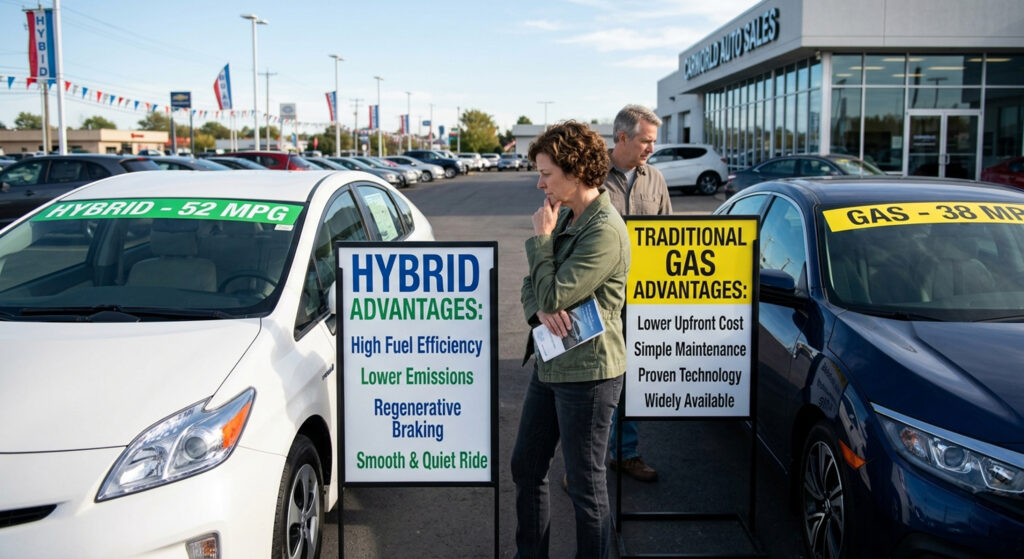
A hybrid car combines a gasoline engine with one or more electric motors powered by a battery pack. The vehicle automatically switches between gasoline and electric power or uses both systems together to improve efficiency.
Unlike fully electric vehicles, hybrids do not require external charging. The battery is recharged through regenerative braking and the gasoline engine while driving.
Popular hybrid models include the Toyota Prius, Honda Accord Hybrid, and Hyundai Elantra Hybrid.
How Hybrid Technology Works
Hybrid vehicles use intelligent systems to determine the most efficient power source at any given moment. During low-speed driving, the electric motor may handle most of the work. At higher speeds or during acceleration, the gasoline engine assists or takes over entirely. This combination helps reduce fuel consumption and emissions.
What Is a Gas-Powered Car?
A gasoline vehicle relies entirely on an internal combustion engine for power. Gas cars have dominated the automotive market for over a century and remain the most common type of vehicle on the road.
Gas-powered vehicles are available in nearly every size, style, and price range, making them a familiar and accessible choice for most buyers.
Why Gas Cars Remain Popular
Gas vehicles continue to attract buyers because of their lower upfront costs, extensive refueling infrastructure, and proven reliability. Drivers can quickly refuel almost anywhere without worrying about batteries or electric systems.
Hybrid vs. Gas Car. Key Differences
Fuel Economy
One of the biggest advantages of hybrid vehicles is fuel efficiency.
A typical hybrid can achieve significantly higher miles per gallon (MPG) compared to a similar gas-powered vehicle. Because hybrids rely partially on electric power, they consume less gasoline during stop-and-go traffic and city driving.
For drivers with long daily commutes, the fuel savings can add up substantially over time.
Purchase Price
Gas-powered vehicles generally cost less upfront than comparable hybrid models.
Hybrid technology increases manufacturing costs due to batteries, electric motors, and advanced control systems. While hybrids may save money on fuel, buyers should consider whether those savings justify the higher purchase price.
Maintenance Costs
Many shoppers assume hybrids are more expensive to maintain, but that’s not always true.
Hybrid vehicles often experience less brake wear because regenerative braking helps slow the vehicle while recharging the battery. However, hybrid systems can be more complex and may require specialized repairs if major components fail.
Gas vehicles have simpler systems but typically require more frequent maintenance such as oil changes and brake replacements.
Reliability
Modern hybrids have proven to be highly reliable. Manufacturers have spent decades refining hybrid technology, and many hybrid batteries last well over 100,000 miles.
Gas-powered vehicles also have strong reliability records, particularly models from established manufacturers. The choice often depends more on the specific vehicle than on the powertrain type.
Environmental Impact
Hybrid cars produce fewer emissions because they burn less fuel. Drivers who want to reduce their carbon footprint without switching to a fully electric vehicle often find hybrids to be an attractive middle ground.
Gas-powered vehicles generally produce higher emissions and consume more fuel, making them less environmentally friendly.
Which Vehicle Saves More Money Over Time?
The total cost of ownership includes much more than the sticker price.
Factors to consider include:
- Fuel expenses
- Insurance costs
- Maintenance
- Repairs
- Depreciation
- Resale value
For drivers who travel many miles each year, hybrid fuel savings can often offset the higher purchase price within several years. On the other hand, drivers with short commutes may find that a gas vehicle offers better overall value.
Example Scenario
A driver covering 15,000 to 20,000 miles annually may save hundreds of dollars per year in fuel with a hybrid. Over five years, these savings can become significant enough to justify the higher initial investment.
Performance Comparison
Many buyers assume hybrids are slow, but modern hybrid vehicles deliver impressive performance.
Electric motors provide instant torque, which improves acceleration from a stop. Some hybrid models are even faster than their gas-only counterparts.
Gas-powered vehicles still dominate in high-performance sports cars and heavy-duty applications, but hybrids have become increasingly competitive across many segments.
Best Choice for City Driving
If most of your driving occurs in urban environments, a hybrid vehicle often makes more sense.
Stop-and-go traffic allows hybrids to maximize electric power usage and regenerative braking benefits. This can lead to substantial fuel savings compared to traditional gas vehicles.
Best Choice for Highway Driving
Drivers who spend most of their time on highways may notice a smaller efficiency advantage from hybrid technology.
Although hybrids still offer excellent fuel economy, gas-powered vehicles can be more cost-effective if highway travel dominates your driving routine.
Resale Value Comparison
Hybrid vehicles often maintain strong resale values because demand for fuel-efficient transportation continues to grow.
Gas vehicles can also retain value well, particularly popular trucks, SUVs, and highly reliable sedans.
Market conditions, fuel prices, and manufacturer reputation all influence resale value.
Who Should Buy a Hybrid?
A hybrid vehicle may be the best option if:
- You drive frequently
- Fuel efficiency is a priority
- You spend significant time in city traffic
- You want lower emissions
- You plan to keep the vehicle for several years
Who Should Buy a Gas Car?
A traditional gas-powered vehicle may be a better choice if:
- You have a limited budget
- You drive relatively few miles annually
- You prefer a lower purchase price
- You want simple maintenance
- You need a wide variety of vehicle options
Final Verdict: Hybrid vs. Gas Car
There is no universal answer to whether a hybrid or gas-powered car is better. The right choice depends on your personal needs and driving habits.
For drivers seeking maximum fuel efficiency, lower emissions, and long-term savings, a hybrid vehicle is often the smarter investment. For buyers focused on affordability, simplicity, and lower upfront costs, a gas-powered vehicle remains a practical and reliable option.
Before making a purchase, calculate your expected annual mileage, fuel costs, and ownership timeline. Doing so will help determine which vehicle delivers the greatest value over the long run.
FAQs
Is a hybrid car worth the extra cost?
For many drivers, yes. Higher fuel efficiency can offset the additional purchase price over time, especially for those with long commutes.
Do hybrid batteries need replacement?
Hybrid batteries are designed to last many years and often exceed 100,000 miles before requiring replacement.
Are hybrids more reliable than gas cars?
Modern hybrids are generally very reliable and often perform similarly to traditional gasoline vehicles in long-term dependability.
Which is cheaper to maintain, hybrid or gas?
Maintenance costs can vary, but hybrids may require fewer brake replacements and consume less fuel, helping reduce overall ownership expenses.
Do hybrids perform well on highways?
Yes. Modern hybrids perform very well on highways while still providing better fuel economy than many conventional vehicles.
Are hybrid cars better for the environment?
Yes. Hybrids typically produce fewer emissions and consume less fuel than traditional gas-powered vehicles.
What is the biggest disadvantage of a hybrid car?
The primary disadvantage is the higher upfront purchase price compared to a similar gas-powered vehicle.
Should I buy a hybrid or gas car in 2026?
If fuel savings and environmental benefits matter most, a hybrid is often the better choice. If affordability and simplicity are your priorities, a gas-powered vehicle may be the smarter option.
Is a hybrid worth the extra cost in 2026?
For most drivers with a regular commute and meaningful annual mileage, yes — the fuel savings typically offset the higher purchase price within three to six years, and the car continues saving money on fuel after that point. For low-mileage or highway-heavy drivers, the payback period stretches out and a gas car may be the more economical pick.
Do hybrids need a different kind of maintenance than gas cars?
No special maintenance schedule is required. Hybrids use the same oil changes, tire rotations, and filters as gas cars, and their regenerative braking system typically means less frequent brake pad replacement.
How long do hybrid batteries actually last?
Most manufacturers warranty hybrid batteries for 8 to 10 years or 100,000 to 150,000 miles, and real-world failures within that window are uncommon. Many hybrid batteries outlast the warranty period entirely.
Are hybrids more reliable than gas cars?
Reliability varies more by manufacturer and model than by powertrain type. Hybrid drivetrains from established manufacturers have a long track record at this point and aren’t inherently less reliable than their gas counterparts.
Do hybrids still qualify for a federal tax credit?
Traditional, non-plug-in hybrids were never eligible for the federal clean vehicle credit. The $7,500 credit that did apply to qualifying plug-in hybrids and EVs ended for vehicles acquired after September 30, 2025, so it no longer factors into a hybrid-vs-gas decision either way.
Is a hybrid better for city driving or highway driving?
City and stop-and-go driving is where hybrids show their biggest fuel-economy advantage, since the electric motor handles low-speed driving efficiently. The efficiency gap narrows at sustained highway speeds, where the gas engine does most of the work.